About AKIVI
What are the origins of AKIVI? What anatomical photo and video sources are included in the AKIVI app? Who are the founders and driving forces behind this dynamic project? How did it establish itself among regional and national academics? What does the future hold for our human anatomy app? Find out all about it below!

Photograph of the neurosurgery operating theater at the Angers University Hospital, where Dr Florian Bernard, pictured, works
AKIVI was born out of an observation. There is a lack of support and guidance in the printed and digital resources available. Guidance that brings together all the certified and therefore legitimate sources for visualizing human anatomy. Students are keen to see the creation of certified content tailored to their level and geared towards practice. Advice from teachers in a language adapted to their level. At a time when health misinformation is rampant, providing content certified by medical specialists is a necessity. This knowledge transmission must be tailored to each individual learner, and must not be based solely on atlases. Thanks to our anatomical and medical experience in the transmission of knowledge and in patient information, we can harness the technological advances of eHealth to serve a unique audience. Each user will be able to find resources to suit their needs.
According to an IPSOS study commissioned by the French government in November 2019, the public believes that the healthcare sector is one of three key sectors where digital development is needed. More specifically, the initial and continuing education sector is falling apart. In 2018, we conducted a survey among 300 French medical students in their 2nd and 3rd year (Source: June Marketing survey). 95% of students called for the creation of a platform like the AKIVI anatomy app. 75% of students use the Internet as their main source of information. However, more than half of them believe that online content is of poor quality, or even misleading.
Our educational science and neuroscience research into visuospatial cognition has given us valuable insights into the benefits of 3D visualization for understanding the human body. We have created the first learning platform focused on explaining and visualizing the human body in 3D (using virtual reality technology on smartphones and computers). Its aim is to explain the human body to students and healthcare professionals in the clearest possible way – using all the educational resources that best stimulate cognitive learning processes.

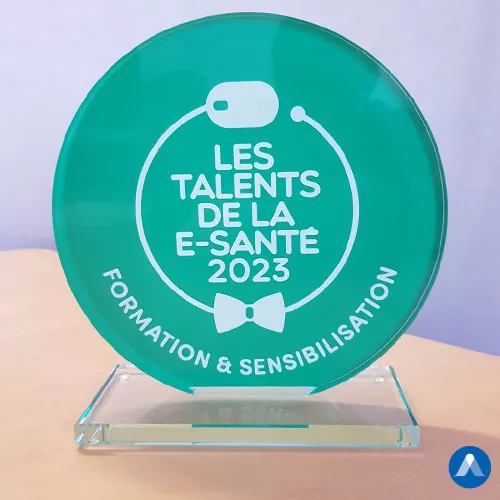
On 18 January 2024, the Agence du numérique en santé awarded the AKIVI anatomy application the “Training and Awareness Prize” at the Talents de la e-Santé 2023 ceremony: recognition from the French government for our work in supporting future healthcare professionals in their training.

– Anatomy learning support features (progressive diagrams with commentary, expert feedback from recognized anatomy professionals, real-life work scenarios) vs. 2D or 3D atlases, which lack learning support tools.
– 3D stereoscopic visualization on a smartphone (depth vision) vs. flat or relief 3D visualization using an expensive VR headset.
– Production of images based on real human organs vs. graphics that do not fully reflect the reality of the human body.
– Educational content tailored to the learner’s level vs. generic content for all learners from competing products.
When it comes to learning anatomy, lectures have played a central role for decades. At the end of the course, students are often left with notes taken during lectures, very dense books, and anatomy plates. These plates feature a multitude of arrows, captions and legends that can be quite confusing. It can be difficult to understand where each structure begins and ends. With AKIVI, students now have a tool in which explanations and legends are introduced progressively and with commentary. AKIVI brings together a comprehensive range of resources on each topic: simple videos to learn the basics, chalkboard lectures, fact sheets summarizing key knowledge points, clinical cases describing the pathologies of the organs studied, quizzes with corrections to prepare for exams, and dissections to understand surgery and radiology.
The AKIVI database includes a wide range of human body 2D and 3D photo and video sources. The digitization of anatomical reference works such as André Latarjet and Léo Testut’s Treatise on Human Anatomy (Traité d’anatomie humaine), or Jean-Baptiste Marc Bourgery’s Atlas of Human Anatomy and Surgery (Traité de l’anatomie de l’homme), has cemented our archiving efforts. In addition to other reference works, various visual archive collections, including those from Stanford University, have been and continue to be added to our own database of photos and videos of the human body and surgery.


For the past seven years, the AKIVI project team at the Faculty of Health of Angers, France, has been using these scientific and anatomical resources to produce videos of the human body. The AKIVI app’s database now contains thousands of photos and videos. The 2D and 3D images and videos of the human body featured in the AKIVI app are certified by a group of scientific experts in human anatomy. These include lecturers and professors of anatomy at Angers’ Faculty of Health, such as Doctors and Professors Florian Bernard, Henri Dominique Fournier and Olivier Trost. AKIVI’s media content is constantly evolving, notably with the regular addition of new audio and video material to complement essential information for in-depth knowledge of human anatomy.
One of AKIVI’s innovations is the creation of a mobile app capable of displaying 3D video content, a feature that is usually the preserve of virtual reality headsets. Thanks to Google Cardboard, the learner’s smartphone (whether a medical student or a healthcare professional) can become a virtual reality headset. In other words, videos are produced in 2D and 3D. The switch happens when using a Google Cardboard, which turns the student’s smartphone into a 3D viewer.

The AKIVI anatomy lab is located at the Faculty of Health in Angers, France (the app’s first historical partner and a committed supporter of the project). When the AKIVI team identified a strong demand from students and started developing 3D technologies, SATT Ouest Valorisation believed in the project’s potential. The organization funded the professionalization of the app and made it possible to register it with the European Agency for the Protection of Programs. This was a real financial and technical boost for AKIVI. This national research promotion scheme helped bring together a multidisciplinary team to build the AKIVI app and develop this new way of learning anatomy. Today, AKIVI brings together medical school lecturers, practitioners from all specialties, Angers students from all levels, as well as developers, graphic designers, video editors, videographers, translators… and also the Lane Medical Library of the Stanford University School of Medicine.
SATT Ouest Valorisation’s entrepreneurial support for AKIVI has been expanded to include new partners and incubators. Angers Technopole conducted a series of market research studies and lean-tested the AKIVI concept in order to support its commercialization across the French academic world. Atlanpole Biotherapies and the Réseau Entreprendre Maine-et-Loire network are supporting AKIVI in its entrepreneurial, academic and commercial development. It’s important to note that new features are still being developed (artificial intelligence, new content, new courses, and an English version). Our vision? AKIVI is a company for healthcare professionals and their patients, with a positive human impact, respectful of all, and with an international reach. We are developing a French-made digital platform, distributed internationally, which harnesses academic excellence and adapts to its users (adaptive learning and AI technology).


AKIVI offers thousands of videos, images, quizzes, 3D dissections and clinical cases to help you learn anatomy anywhere you are.
Simply install our app on your smartphone! All you need is an email address and a password to create your “Freemium” account and use AKIVI free of charge on your mobile, tablet or computer.

AKIVI offers thousands of videos, images, quizzes, 3D dissections and clinical cases to help you learn anatomy anywhere you are.
Simply install our app on your smartphone! All you need is an email address and a password to create your “Freemium” account and use AKIVI free of charge on your mobile, tablet or computer.

This website uses a GDPR analytics tool that protects your privacy.